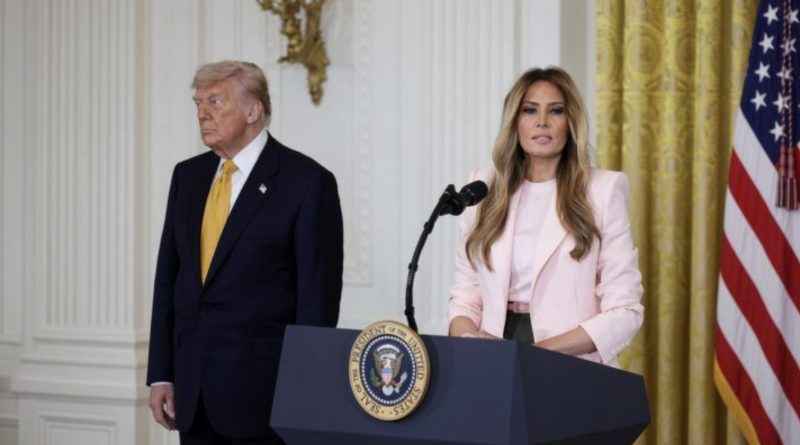
First Lady Melania Trump is exerting influence again on her husband’s agenda, and it’s a positive thing for American women. Melania unveiled a major new women’s health initiative Monday as President Donald Trump signed an executive order creating a White House task force and a new division within the National Institutes of Health aimed at improving research, treatment and care for women throughout their lives. The initiative, titled “Advancing Women’s Health to Improve Outcomes in All Phases of Life,” directs the Department of Health and Human Services to establish a Women’s Health Division within the NIH within 90 days. The order also creates the White House Women’s Health Task Force, which will be co-chaired by Health and Human Services Secretary Robert F. Kennedy Jr. and White House Chief of Staff Susie Wiles.
Melania played a central role in developing the initiative, holding meetings with physicians and other experts and pushing the administration to address what the White House describes as longstanding gaps in medical research involving women. “This is a transformative moment for women in America,” the first lady said during the White House announcement, declaring that the administration intended to establish a new standard for women’s health. NIH Director Jay Bhattacharya said the division is intended to close lingering gaps in medical evidence and help bring scientific discoveries closer to patients, particularly in areas where women have historically lacked clear answers about diagnosis and treatment.
The new NIH division will focus on diseases and medical conditions that uniquely or disproportionately affect women, including cardiovascular disease, cancer, stroke, Alzheimer’s disease, autoimmune disorders, osteoporosis, chronic pain, endometriosis, fibroids, infertility, maternal health and menopause. It will work alongside the existing NIH Office of Research on Women’s Health rather than replace it, with the administration directing the new division to coordinate research and help translate scientific discoveries more quickly into prevention, diagnosis and treatment. The executive order also calls for increased participation of women and girls in clinical trials and stronger enforcement of NIH requirements that federally funded research account for biological sex when appropriate.
Five Priorities for Women’s Health
Melania outlined five priorities for the effort, beginning with directing research funding toward diseases that uniquely affect women and using advanced artificial intelligence technologies to improve scientists’ understanding of female biology. Her other priorities include accelerating promising therapies from laboratories to patients while maintaining safety standards, making medical breakthroughs more accessible and affordable and encouraging greater education and discussion about women’s health issues that historically received less public attention. “Our mission must serve women at every stage of life,” the first lady said, describing an approach stretching from childhood through motherhood, middle age, menopause and later life.
Trump praised his wife for driving the proposal and said the administration intends to pursue additional research into diseases affecting women that have historically been understudied. The president acknowledged that he initially questioned whether NIH already had such a dedicated division when Melania approached him about the idea, although the agency has operated an Office of Research on Women’s Health since 1990. The new task force held its first working session Monday afternoon following the White House ceremony, beginning the process of coordinating women’s health policies across federal agencies.
Lifespan Approach to Women’s Health
The administration says the effort will take a lifespan approach rather than treating individual conditions separately, covering health needs from infancy and adolescence through reproductive years, pregnancy, midlife, menopause and healthy aging. HHS pointed to several earlier administration initiatives as part of that broader strategy, including expanded research into infertility and endometriosis, changes involving menopause treatment, maternal health programs and a proposed pathway for certain fertility benefits. The department also held its first National Conference on Women’s Health in March, bringing together researchers, physicians, policymakers and advocates to discuss gaps in treatment and medical research.
The executive order does not specify a new dollar amount for the initiative, leaving questions about precisely how much additional federal funding will ultimately be directed toward the new NIH division and its research priorities. The order also revokes former President Joe Biden’s March 2024 executive order on women’s health research and a November 2023 presidential memorandum establishing the Biden White House Initiative on Women’s Health Research.