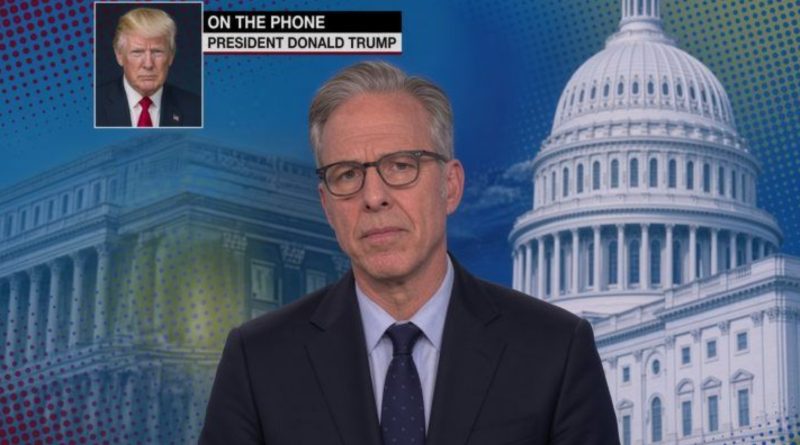
WASHINGTON – President Donald Trump’s recent exchange with CNN anchor Jake Tapper has renewed discussion about the relationship between the White House and major news organizations, particularly after Trump said his administration was trying to have CNN “go on a normal path.” The comment came during a July 12, 2026, telephone appearance on CNN’s State of the Union. Trump had called the program to discuss the death of Sen. Lindsey Graham, a longtime Republican ally who had died the previous day. Tapper briefly attempted to move the conversation toward the latest developments involving Iran, but Trump declined to discuss other issues, saying he wanted to focus on Graham out of respect for the senator.
As the conversation came to an end, Tapper invited Trump to return for a more extensive interview. Trump then added: “We’re trying to have CNN go on a normal path, and we’ll do that.” Tapper replied that he was already on a “normal path,” thanked the president for appearing and ended the exchange. CNN’s transcript confirms the wording of the conversation. Trump’s statement immediately became a subject of discussion because it did not explain what he meant by a “normal path” or what actions, if any, the administration was taking toward CNN.
Trump has repeatedly criticized CNN and other major news organizations over their coverage of his presidency. His comments about the network have frequently centered on disagreements over its reporting and editorial approach. The July exchange, however, does not by itself establish that the White House has directed CNN’s editorial decisions or exercised control over its newsroom. That distinction is important when separating a political statement from evidence of government intervention in journalism.
Media Industry Restructuring and Regulatory Review
The remarks instead became part of a broader debate over the relationship between elected officials and news organizations, especially when political leaders publicly criticize media outlets or call for changes in their coverage. The exchange also occurred during a major restructuring of the American media industry. Warner Bros. Discovery, CNN’s parent company, agreed to be acquired by Paramount Skydance in a transaction valued at roughly $110 billion. In June, the Justice Department’s Antitrust Division announced that it had completed its review and concluded that the proposed transaction was not likely to harm competition or American consumers.
The Justice Department’s decision was specifically an antitrust determination. Its review examined potential effects on competition in areas including streaming video, linear television and film production and distribution. It did not establish that the transaction would give the Trump administration control over CNN’s editorial operations. The proposed merger nevertheless generated considerable attention because it would place CNN and CBS News within the same corporate structure.
The ownership changes have prompted broader questions throughout the media industry about how corporate ownership can affect news organizations. Those questions became particularly prominent because the transaction involved two major American news operations. Media observers have debated how changes in management, ownership and corporate strategy could affect newsroom priorities and coverage. The latest developments have added another layer to that discussion.
Editorial Independence and Oversight Board
On September 21, Paramount reached settlements with a group of states that had challenged the Warner Bros. Discovery acquisition. Under the reported agreement, the combined company would establish an independent editorial oversight board intended to protect editorial independence at CNN and CBS News. The settlement still requires judicial approval. The creation of such an oversight structure reflects concerns raised during the regulatory and legal review, although the precise effect of the arrangement on newsroom operations will depend on how it is implemented.
Trump’s relationship with CNN has been contentious for years. During both his first and second presidential campaigns and administrations, he has frequently criticized the network and accused major news organizations of unfair or politically motivated coverage. CNN, meanwhile, has maintained that its journalists operate according to editorial and professional standards. The July interview illustrated the unusual nature of the relationship. Trump was willing to appear on CNN to discuss Graham but declined to discuss Iran during the interview. At the same time, he suggested that his administration was interested in changing the network’s direction.
The statement was brief and lacked specific details about what “normal” meant or what measures Trump was referring to. The episode highlights a broader issue in American public life: how political leaders interact with an independent press. Presidents routinely criticize news organizations, challenge individual reports and attempt to shape public narratives. News organizations, in turn, maintain editorial independence and decide which issues to cover and how to report them.
Constitutional Framework and Future Implications
The constitutional framework protecting freedom of the press is central to that relationship, while private media companies remain subject to corporate ownership and management decisions. The available record from Trump’s conversation with Tapper does not demonstrate that the administration has taken control of CNN’s journalism. It does, however, provide another example of the president publicly commenting on the network’s direction. As the Paramount-Warner Bros. Discovery transaction moves through its remaining legal and corporate steps, questions surrounding media ownership and editorial independence are likely to remain prominent.
For CNN, the developments involve both a change in corporate ownership and continued public scrutiny from the president. For the broader news industry, the episode illustrates the continuing tension between political power, corporate media ownership and the independence of journalists. The significance of Trump’s “normal path” remark will ultimately depend on what, if anything, the administration and CNN’s future corporate leadership do in response. For now, the statement itself provides no specific evidence of government control over CNN’s editorial decisions.